

Empathize
Context Canvas
Why Use this tool ?
Understand your company in its wider environment
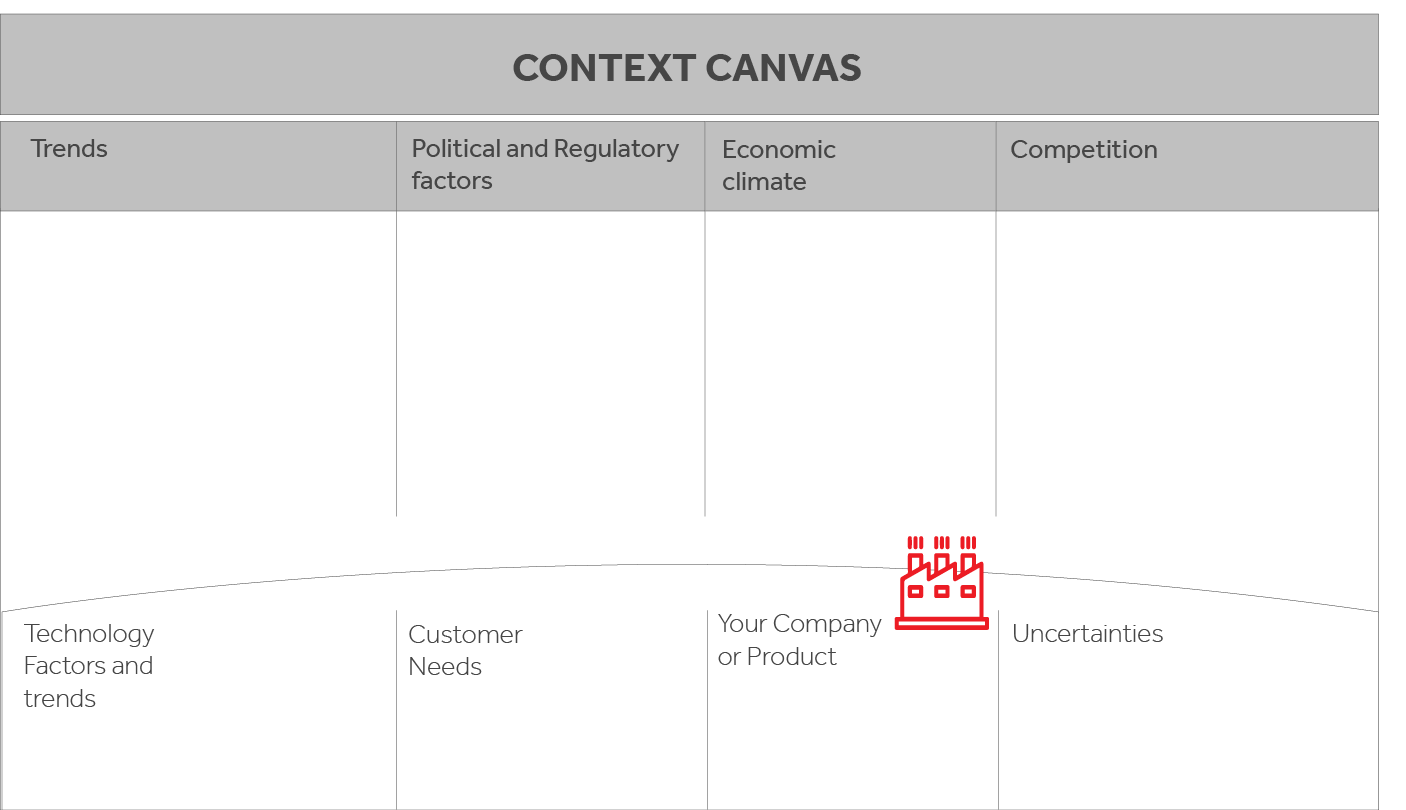
The Context Canvas pushes teams to zoom out and see beyond internal discussions. It highlights the political, economic, technological, competitive, and cultural factors that may affect your choices. By mapping these forces side by side, you create a shared understanding of the external drivers, and the uncertainties that could shape your future.
what you should know
Start With: Research, discovery insights, and team knowledge
End With: A shared visual map of the main external drivers and uncertainties
Time Needed: 30 – 60 min
Difficulty: ⭐ ⭐ ☆☆☆ (2 out of 5 – structured but easy to use in groups)
A quickguide to start
1. Start from the center. Write your company or product in the middle box, this is your anchor.
2. Choose your lenses. Decide which external factors are most important to consider for your project (Trends, Politics, Regulatory, Economic).
3. Split the work. Assign sections to small groups or discuss them one by one.
4. Map insights. Brainstorm and capture short, clear statements in each section. Focus on what may influence or impact your company.
5. Bring it together. Share findings, compare perspectives, and highlight the most important drivers to keep in mind.
helpful tips
- Keep the center (your company or product) short and focused, don’t let it become an internal SWOT.
- Revisit the canvas as the environment changes; it’s a living snapshot, not a one-time exercise.
- Pay special attention to “Uncertainties”, they often signal the areas where you need to monitor closely or design flexible strategies.
Start filling the format
RACU meets AI
Context Canvas
How Can AI Make RACU Easier ?
AI can be your creative partner and research assistant, ready to help you move faster and think deeper at every step of the RACU process.
For each RACU tool, we’ll share a ready-to-use AI prompt. Just copy the prompt into your favorite AI tool (like ChatGPT or Copilot) and it will guide you through the method step by step.
The AI becomes your facilitator, asking the right questions so you can build your thinking as you go. No need to fill out a blank form, the prompt starts the conversation and adapts to your answers in real time.
PROMPT – COPILOT, CHAT GPT
You are an innovation and foresight assistant helping me complete a Context Canvas for a design thinking challenge.
Your role is to proactively suggest external factors that may influence my company or product, while asking me to validate, adjust, or add details.
The Context Canvas has my company or product at the center, and the following sections around it:
- Trends
- Political & Regulatory Factors
- Economic Climate
- Competition
- Technology Factors & Trends
- Customer Needs
- Uncertainties
🔰 Step 1 – Define the Focus
Start by asking me:
👉 “What company, product, or project should we place in the center of the canvas?”
→ Use my answer as the anchor for all following suggestions.
🔎 Step 2 – Suggest and Validate External Factors
Go section by section. For each one:
- Suggest 3–5 external factors or drivers relevant to that section (based on my context + your foresight knowledge).
- Present them in a clear bullet list.
- Ask me:
👉 “Which of these seem most relevant? What should we adjust, remove, or add?”
- Refine the section with my input, then continue to the next.
👀 Step 3 – Connect the Dots
Once all sections are filled, analyze and tell me:
- Which factors seem most critical for my company/product.
- Where there are cross-category connections or tensions.
- Which uncertainties I should monitor closely.
📌 Final Step – Deliverables
At the end, give me:
- A completed Context Canvas in table format with all sections filled in.
- A short summary of the top external drivers and uncertainties.
- A list of key references or sources you used (reports, articles, datasets, or general industry knowledge). Keep it short — just enough for me to explore further. Include links.
⚡️ Important for You (the AI):
- Start executing immediately, don’t just repeat the instructions.
- Be proactive: provide concrete suggestions for each section without waiting for me to list everything.
- Keep statements short, specific, and easy to scan.
- Adapt suggestions to the company/product I gave you in Step 1.
- If I’m unsure, offer examples I can accept, reject, or refine.

Copilot