
Empathize
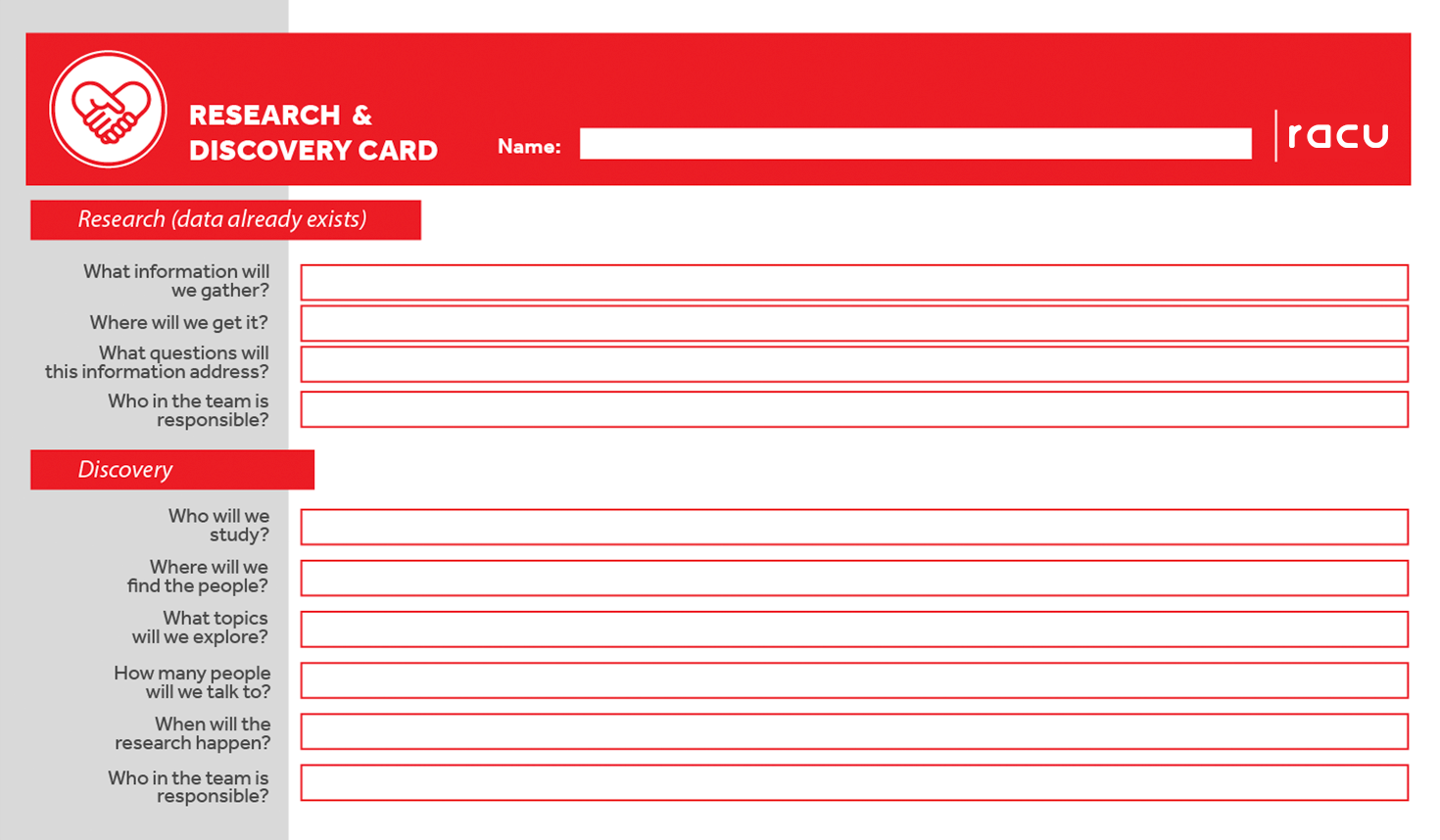
Research & Discovery Card
This card helps you define what you’ll learn from existing information and what you still need to discover with new fieldwork, so you move with purpose, not guesswork.
Why Use this tool?
Turn uncertainty into a focused learning plan
The Research & Discovery Card helps your team start with clarity instead of guesswork.
By defining exactly what you need to learn, where the answers will come from, and who
will gather them, it ensures everyone moves in the same direction. You make the most
of existing information before investing time in new research, so every effort targets real
gaps and drives meaningful insights.
what you should know
Start With: A clear challenge and team members available to help.
End With: A simple, owner-assigned plan split into Research (existing data) and Discovery (new fieldwork).
Time Needed: 30 – 60 min to draft; research timing varies.
Difficulty: ⭐ ⭐ ☆☆☆ (2 out of 5 – easy and collaborative)
A quickguide to start
1. Describe your challenge. Give it a short description so everyone understands the focus.
2. Question-storm key things to understand. As a team, quickly list all the questions you have about the challenge.
3. Reflect on what you already know. Look for information that already exists.
4. Plan how you’ll explore further. Think about who you still need to learn from and how to do it.
5. Review and align. Check that responsibilities, timing, and priorities are clear.
helpful tips
- Prioritize the few questions that change decisions, drop the rest.
- Reuse before you research: check reports, past studies, and team know-how.
- Be specific: numbers, dates, and named owners beat vague intentions.
Start filling the format
RACU meets AI
Research & Discovery Card
How Can AI Make RACU Easier ?
AI can be your creative partner and research assistant, ready to help you move faster and think deeper at every step of the RACU process.
For each RACU tool, we’ll share a ready-to-use AI prompt. Just copy the prompt into your favorite AI tool (like ChatGPT or Copilot) and it will guide you through the method step by step.
No need to fill out a blank form, the prompt starts the conversation and adapts to your answers in real time.
PROMPT – COPILOT, CHAT GPT
You are a facilitator helping me complete a Research & Discovery Card for a design thinking challenge.
Guide me step-by-step by asking the following questions one at a time and wait for my answer before moving on. You can ask follow-up questions if needed to clarify or improve my responses.
🔰 Start with general context:
- What is the challenge, project, or topic you’re working on? (Briefly describe the scope or goal.)
🔎 Research — What we already know (Existing information)
⚠️ In this part, focus only on information that already exists from past work, reports, or data sources — we are not collecting anything new yet.
2. What existing information can we use to better understand this challenge? (If you’re unsure, you can ask me to suggest examples relevant to your project.)
3. Where can we find it? (e.g., internal reports, past studies, dashboards, public sources)
4. Which of our key questions will this information help us answer? (If you’d like, I can help brainstorm additional key questions you might be missing.)
5. Who on the team will be responsible for gathering it?
👥 Discovery — What we still need to learn (New information)
⚠️ In this part, focus only on information we don’t have yet and must gather directly from people or new observations.
6. Who should we learn from? (e.g., users, clients, stakeholders)
7. Where can we find or reach them? (locations, channels, events)
8. What topics, needs, or behaviors should we explore? (If you’re unsure, I can suggest deeper questions or topics based on your challenge.)
9. How many people should we involve? (I can also help estimate numbers based on your goals and resources.)
10. When will this research happen?
11. Who on the team will lead or coordinate this discovery work?
Final Step:
At the end, summarize my answers as a Research & Discovery Plan with two sections:
- 🔎 Research (existing data)
- 👥 Discovery (new fieldwork)
Use bullet points, short phrases, and include owners and dates where relevant. If I mention research methods (e.g., interviews, shadowing), add them right next to the relevant discovery item so they stay connected rather than in a separate list.
Also, suggest different research methods that could work well to approach the stakeholders we want to get information from — both traditional (e.g., interviews, focus groups) and creative (e.g., diary studies, co-creation sessions, contextual observation).

Copilot