What is RACU ?
RACU goes beyond a methodology, it’s a flexible mindset designed to approach challenges with a human-centered perspective. It focuses on understanding users’ contexts, exploring opportunities through experimentation, and iterating based on feedback. RACU is flexible and it is structured around five key steps. It adapts to various situations, whether creating a product, improving a process, or addressing user needs.
Key Benefits of Adopting RACU
User-Centered Solutions
Creating solutions that truly meet users’ needs and expectations.
Reduced Risk and Uncertainty
Validating ideas early and often, ensuring that resources are invested in solutions that work.
Collaboration and Creativity
Encouraging cross-functional teamwork, unlock creative potential by exploring diverse perspectives.
The 5 Steps of RACU

STEP 0

Empathize

define

ideate

prototype
improvement

prototype
testing
Let’s Understand Each Step
STEP 0: Know your Challenge
Define Where to Focus
What happens?
- Identify and select a relevant topic to explore, one that feels strategic, timely, and meaningful.
- Frame the initial challenge and clarify what success could look like.
Outcomes:
Your output is a well-defined challenge
Execution Time:
1 week
STEP 1: Empathize
Understand the People You’re Designing For
What happens?
- Explore the user’s world through observation, interviews, and engagement to gain a deep understanding of their needs, emotions, and behaviors.
- Identify the context, culture, and environment that influence their experiences.
Starting point:
Your input for this step is the Challenge, from step 0.
Outcomes:
Your output for this step are Findings
Execution Time:
3 weeks

STEP 2: Define
Frame the Right Problem
What happens?
- Synthesize key findings to reveal patterns and deeper meanings.
- Transform discoveries into clear insights that define the core problem or opportunity to address.
Starting point
In this step you put all the Findings, you got on Step 1: Empathize
Outcomes
In this step you get insights, problem or opportunity
Execution Time:
1 week

STEP 3: Ideate
Generate and Select Ideas
What happens?
- Encourage brainstorming and creative thinking to explore a wide range of ideas.
- Select and refine ideas that best align with user needs and project goals, shaping them into workable concepts.
Starting point
Your input for this step are the insights, problem or opportunity define in step 2.
Outcomes
In this step you get ideas and concepts to work on.
Execution Time:
2 weeks

STEP 4: Prototype Improvement
Build to Learn
What happens?
- Develop quick, low-cost prototypes to explore potential solutions.
- Test and refine these prototypes based on user feedback, leading to the creation of a Minimum Viable Product (MVP) that addresses key needs.
What is your input for this step?
Your input for this step are the concepts and ideas you can work on.
What is the output for this step?
In this step you get an MVP validated in a controlled environment.
Execution Time:
3 weeks
STEP 5: Prototype Testing
Validate in the Real World
What happens?
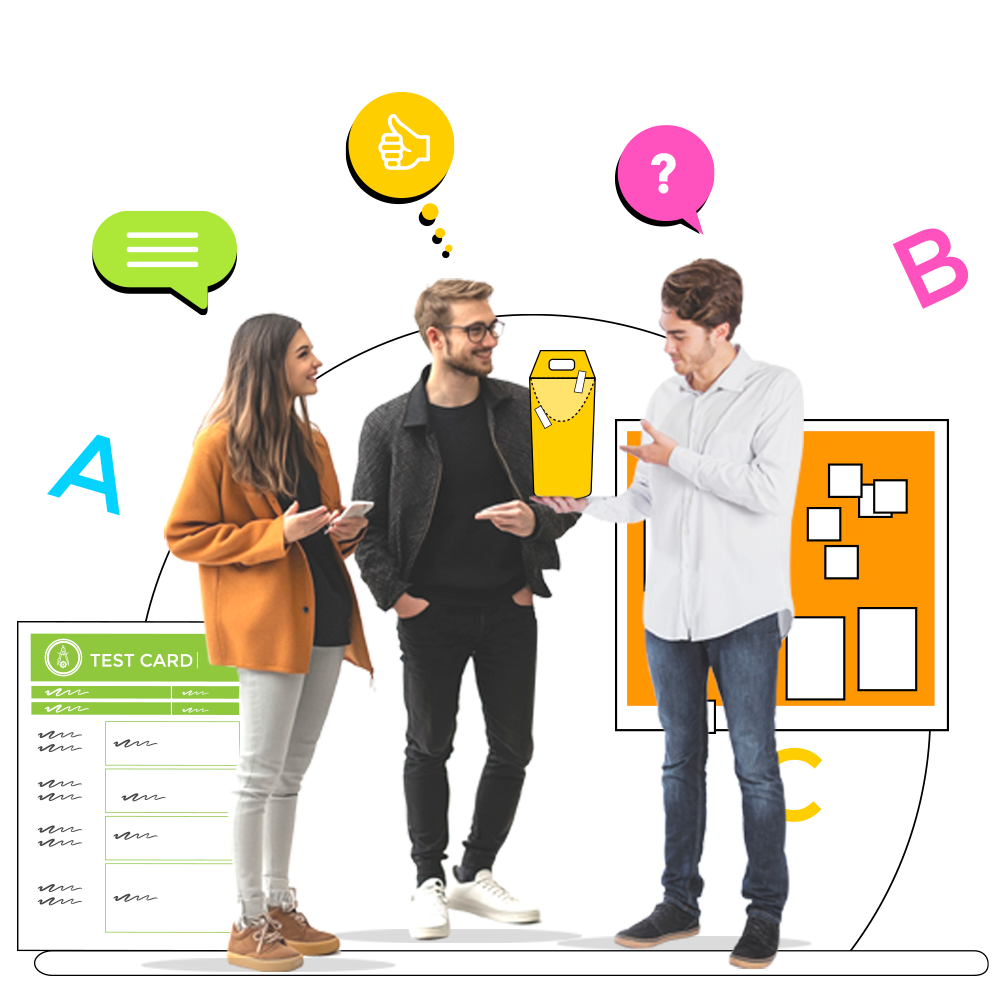
- Test the MVP in real-life environments to assess performance and relevance.
- Gather user feedback for final adjustments or to validate the solution for launch.
Starting point
Your input for this step is an MVP validated in a controlled enviroment.
Outcomes
In this step you get an MVP validated in real-life enviroments.
Execution Time:
6 weeks